Tuesday, July 23, 2019

Gone broody

The hens run back and forth in their yard as I approach the gate. They either think its a feeding opportunity or I'm going to give them a little "free range" time. They can't roam loose continually because of all the bald eagles and raccoons in our area. An eagle would have no problem making a quick meal out of one of our hens given the opportunity. So we give the girls limited, supervised outdoor time.

When I open the gate, out they rush with their wings flapping. Sometimes they'll take flight and zoom over the grass about two or three feet in the air. They can only sustain this for a brief time because, even though they have fully feathered wings, they are big-bottomed girls which isn't favorable for long flights. As I watch them happily cavorting about, I notice we are short one chicken. This usually means one girl is "at work" laying an egg.

I open the door to the coop and, sure enough, there is a hen in one of the three nesting boxes my husband Paul built. However, there's something wrong with her demeanor. She doesn't have the patient look of a laying hen. In fact, she looks downright angry. I notice her feathers are ruffled and she eyes me with contempt as if daring me to reach under her for the egg.

In fact, she looks downright angry. I notice her feathers are ruffled and she eyes me with contempt as if daring me to reach under her for the egg.
"Rats!" I think to myself. "She's gone broody." This sounds like "gone fishing" but it's not nearly as much fun. When a hen has "gone broody," she decides she wants to hatch out some eggs. This would be fine if the eggs are fertilized but ours are not as we have no rooster. And to complicate matters more, the only "egg" she's sitting on is a white golf ball. We put a golf ball in each nesting box to make the hens think one of their sisters has already done her job and so they better get busy.  It really helps. You could also use small round rocks but I like the white golf ball method. They just seem to be less cold than a rock. Broodiness typically lasts three to four weeks and during this time some hens will lose weight because they aren't eating and drinking regularly. Breaking a hen of her broodiness will help ensure that she will eat when hungry and drink when thirsty. It will also help with their anger issues as broody hens are more aggressive.

She ruffles her feathers even more if possible and glares at me.

I know how futile it would be for her to try and hatch a golf ball, so I reach in and grab that girl, lifting her out of the nesting box and setting her down in the grass outside the coop. She stands there in the bright sunshine blinking and looks stunned. She ruffles her feathers even more if possible and glares at me. Then she runs around the outside of the hen yard and coop looking for a way to get back in.  I had shut the gate so she searches in vain. I go to the shed where we keep the feed and get a handful of scratch corn (A.K.A chicken ambrosia). I sprinkle it in front of her. She ignores it at first and then one of the golden kernels catches her eye and she pecks it up. The next moment she's doing what I call the "chicken two-step:" one step forward to scratch with head up, one step back to peck with head down. "Now we're getting somewhere," I think. This repetitive dance is typical chicken behavior and just what I want to see. Pretty soon she's relaxed her feathers and they lie closer to her body. She's also not as agitated.

I hang out on the warm grass with the girls watching them be chickens. It's quite relaxing. I highly recommend it as a pastime. The broody hen lays down in a designated "dusting hole", a depression in loose dirt where the hens can take a dust bath. It's the chicken equivalent of a spa treatment. She rolls around flipping dirt all over herself in an effort to get as filthy as possible. The dirt helps prevent parasites such as lice and mites from finding a home in her feathers and legs.

When she finishes her dust bath, I round up the flock and herd them back into the pen. I take heart that the broody girl doesn't go straight into the coop but instead stops to take a drink of water. But I know we've still got more broody days ahead of us. But that's okay. If I go out tomorrow and I'm met by a girl with angry eyes and ruffled feathers, I'll just put her out in the sunshine - maybe with a nice glass of Pinot Noir.

Cheers!


MID BITE
11x14 inches, oil on linen canvas, 2019
BUY THIS PAINTING AT AUCTION Click on this link to bid: https://ebay.to/32FS8ZY
Mid Bite - auction ends on Sunday, July 28th at 9:00am PST. 
A young filly pauses mid chew to wonder just what the heck am I doing in her pasture.


Tuesday, May 28, 2019

The maternity ward

The light was dim inside the garage as Paul and I put on our sneakers in preparation for our morning walk. Through the window of the door leading to the outside, we could see the brilliant red blossoms of one of our rhododendron plants. This particular Rhodie is always the first to bloom of the several we have on our property and was doing so in spectacular fashion. We opened the garage door and were greeted by a brown flash of feathers as a small bird darted from somewhere underneath the eaves. "I've been seeing that little bird for the past couple of mornings," said Paul. "I think her nest is around here someplace, but I can't find it."

We often find birds nesting around the house and try to leave them alone during their maternity period. One year, an industrious little sparrow built her nest in one of the hanging flower pots just outside our kitchen window. Paul found it before her eggs were laid and removed it. He didn't want to accidentally drown any chicks while watering if he forgot they were in there. For the next week, that little bird gave us the stink eye and hollered her disgust every time we went out on the deck. Fortunately, in time, she flew off in search of a better spot for her nursery.

Paul and I spent several minutes looking for a nest before embarking on our walk. The flashy Rhodie was an obvious spot because it had held a nest for years that had been home to several generations of birds. But the nest eventually disintegrated and Paul found it's remains at the base of the plant last spring. I thought the little bird might have been a swallow and began looking for a mud nest up under the eaves of the garage. Out at the barn, where I keep my horse Mac, swallows rule the roost. They flit in and out of their mud homes, leaving chirping chicks behind in search of all of the insects that come with livestock. We welcome them in spite of the little hillocks of poop they leave behind. But we spotted no nests, mud or otherwise, so we headed out for our walk.

Thoughts of the little bird were lost as we set about the business of getting on with our Saturday. I was in my studio on the computer perusing recipes for the weekly grocery list when Paul called out. "Hey Stace," he said. "I found the nest." He was standing outside the garage near the big red Rhodie grinning. "Where is it?" I asked looking again to the eaves. "Turn around," he said indicating that I should face the door that I just emerged from. I looked closely at the door and then I saw it.

Next to the door, Paul had hung an artificial wreath that he had purchased last year at the big community garage sale hosted by our local Lions club. He liked the the pop of color the wreath added to the front of the garage. Apparently, the little mother bird agreed with him because she built her nest in the center of the wreath. We peered inside and saw four tiny, speckled eggs. So just like that, the outside of our garage became a maternity ward. After some quick searching of nests and eggs online I'm thinking we have the beginnings of a family of wrens. Only time will tell. In the meanwhile, we'll tiptoe in and out of the garage so as not to wake the children.


Welcome Spring!


14x11 inches, oil on linen canvas, 2019

BUY THIS PAINTING AT AUCTION Click on this link to bid: https://ebay.to/2WlpZr3
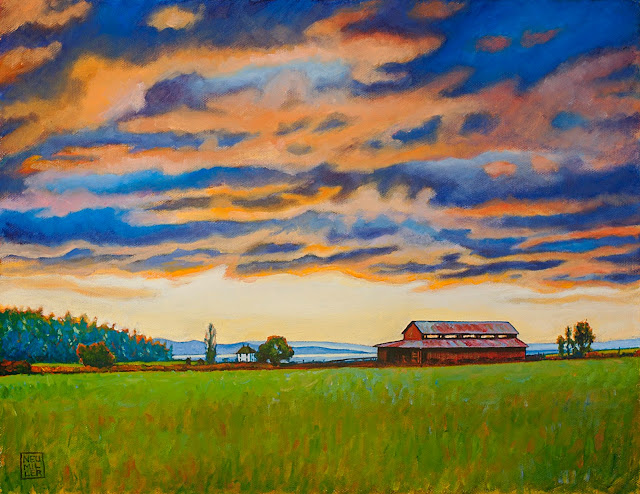
West Beach Sunset - auction ends on Sunday, June 2nd at 9:00am PST. 
Another amazing sunset frames a barn on Whidbey island.

Monday, March 4, 2019

We can make it in the shop

Spring. A season bursting with daffodils, tulips, bright green new grass and the frantic chirping of baby birds insisting on being fed by their mothers. As a seven year old tomboy, I can tell you, none of that made the slightest impression on me. I only knew that I could wear a lighter jacket and play outside longer. My heavy, wool coat was pushed to the back of the closet and my galoshes were banished to the bottom of the boot box.

Spring also meant putting my Flexible Flyer sled back into the barn and fishing out my bicycle. Or, I should say tricycle, because at that time I still didn't have a two-wheeler. I had watched with envy my older brother Stephen and sister Susan zipping around on their bicycles and knew I wanted some of that action. I yearned for a two-wheeler and told my Dad as much one evening after supper.

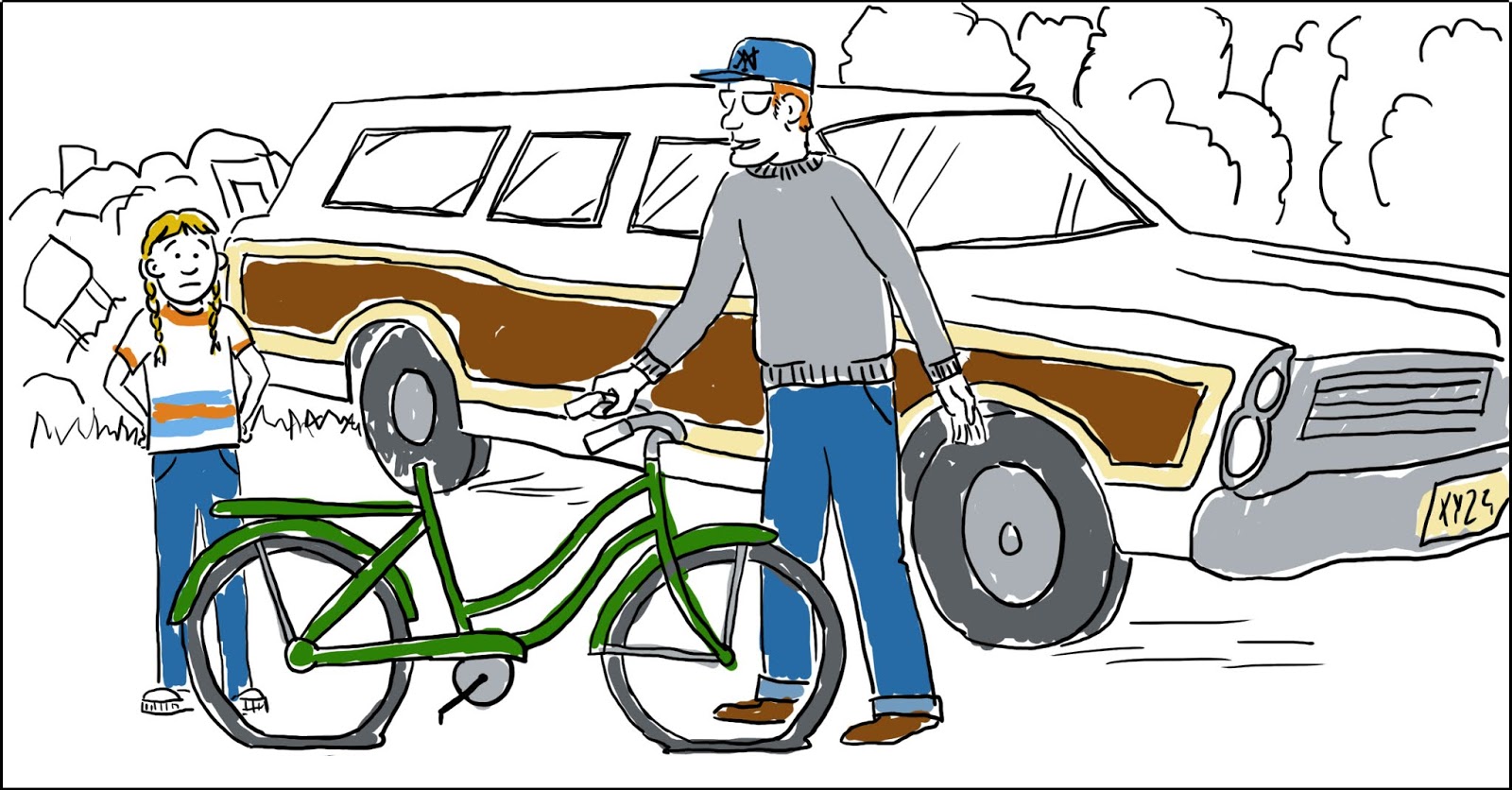
"Well," he said. "I have to go to the dump this Saturday. We'll see if we can find you a bike there." I was elated! Our dump was like an open pit treasure chest. Back then, foraging at the dump wasn't given a second thought, in fact it was encouraged. The more you took home the less the county had to dispose. On that Saturday, Dad loaded up the back of the station wagon (a mid-1960's white Ford Country Squire with real faux-wood siding) with the larger items that wouldn't fit into our garbage cans. My brother Steve joined Dad and me and we made our way over to the dump. Steve viewed the dump as his own parts warehouse. He had a fledgling business repairing lawnmowers and usually found something in the pit he needed for his enterprise.

After arriving, the attendant directed us to the open pit and Dad backed the station wagon down to it's edge. He unloaded our items and the picking began. Steve noticed some discarded lawn mowers and went over to investigate. Dad and I scanned the pit but the few bikes we saw were too large. Then, partially buried, we saw a small bike tire protruding from the pile. Dad grabbed the tire and pulled a pint-sized, green two-wheeled bicycle from the heap. He stood it up next to the car and we inspected it. It was the correct size and the tires, although lacking air, still had good tread. The fenders had minor dents but the paint still had some shine.


"This one looks pretty good," said Dad. "But Dad," I protested. "It doesn't have a seat or pedals!" "Don't worry," he replied. "We can make it in the shop."

"This one looks pretty good," said Dad. "But Dad," I protested. "It doesn't have a seat or pedals!" "Don't worry," he replied. "We can make it in the shop." Triggering a seven year old's eye roll.  This was a common expression we heard from Dad. He did indeed have a wood shop which was located in the hayloft of our barn. We believed he could make anything in it because he generally did. Wonderful things came out of that shop, from a beautiful china hutch to kitchen cabinets with butcher block counter tops. Our breakfast room addition had its genesis in that shop. So, of course, he could make a bicycle seat and pedals. Compared to a room addition or a piece of furniture those would be a piece of cake.

I should also mention here that Dad used the "We can make it in the shop" line as a bit of a "delay and avoidance mechanism" with us kids when circumstances called for it. If we were out at a store and noticed something we wanted to buy, Dad would casually say "Why buy it? We can make it in the shop." Then he would move on with us trailing behind hoping we would forget about the item by the time we got home. In most cases, we did.

But I wasn't going to forget that bicycle. We brought it home and placed it in the barn with the promise of new "Made in the Shop" seat and pedals to come. No more was done with it that weekend. During the week after school, I visited my bike knowing the only thing that stood in the way of two-wheeled bliss was a seat and a pair of pedals. I pestered Dad to begin work on my bike but he was too tired from his job. Saturday finally arrived and my entreaty began anew. Dad knew I could be persistent so after breakfast he headed out to the shop.

A short time later, he appeared in the backyard with the little bicycle. The tires were inflated and it sported a new seat and pedals made of wood. He also had located and attached our set of training wheels. He beckoned me over and held the bike steady as I climbed on board. I practiced all morning and in the afternoon the training wheels came off. Once again, Dad held me steady before giving me a little shove and I wobbled forward through the warm, fragrant spring air.

Thanks Dad.


THIS WAY AND THAT
10x8 inches, oil on linen canvas, 2018
BUY THIS PAINTING AT AUCTION Click on this link to bid: https://ebay.to/2T90ng2
This Way and That - auction ends on Sunday, March 10th at 9:00am PST. 
If you’ve ever had the pleasure of watching a group of hens out scratching and pecking, you’ll know that their progress is far from straightforward. Instead, they meander this way and that in their search of the perfect morsel.

Tuesday, January 8, 2019

Following the Stars


I felt the movement before I heard it. It came from beneath our bed. Our dogs, Buster and Chelsea, were stirring from their usual sleeping spot underneath our four-posted king size bed. They both crawled out and began walking around the bed. That meant only one thing, they needed to go out and use the facilities. I glanced over at the mound of my slumbering husband who was snoring gently. Beyond him the bedside clock read 2:17am. One of the dogs whined faintly. "Alright," I thought, "the sooner I take them out, then sooner I can return to the warm haven of my bed." I gently slid from the bed and quickly threw on some sweats.

At the time, my husband, two young sons and I had just relocated and were living in a two story rental house in Coupeville, Washington. I'm not sure what time of year it was but it was cold and there was snow on the ground so I'm guessing early January 2002. We were still reeling from the events of of September 11, 2001. What happened that night soothed me and brought perspective back to my world.

The dogs and I padded down the darkened carpeted hallway, made a right turn, and descended the stairs to the main floor of the house. From there, we made our way through the kitchen to the door leading to the backyard. The cold hit me as soon as I opened the door, sharp and crisp. The dogs shuffled out and began sniffing about searching for the perfect spot to relieve themselves. I stood on the deck just outside the door watching their dark shapes move among the shadows. I glanced up and was immediately struck by the vastness of the night sky. There are few lampposts in Coupeville so the night sky is wonderfully dark. Thousands of stars were sprinkled among the inky darkness, occasionally winking. That, by itself, was a sight to behold until I saw the first shooting star: a bright pin prick of light streaking across the dark expanse. Then a few moments later another one catapulted from left to right. From that time on, the stars flitted back and forth every 20 seconds or so.

I was transfixed. Time, the dogs, and the cold, they all melted away as I stood there watching the heavens put on a first-class, silent fireworks show. Eventually, the luminous projectiles slowed their pace and I felt a cold, wet nose bump my hand. I looked down to see the furry faces of Buster and Chelsea. I took one last glance at the sparkling night sky before turning and herding the dogs back inside. I felt insignificant and cheered at the same time.

Happy New Year!


THE FOUR SENTINELS
14x11 inches, oil on linen canvas, 2018
BUY THIS PAINTING AT AUCTION Click on this link to bid: https://ebay.to/2RbKd4x
The Four Sentinels - auction ends on Sunday, January 13th at 9:00am PST. 
Four sentinel poplar trees watch over an aging farmstead in the Skagit Valley in Washington state.

Tuesday, October 23, 2018

All in the name of jam

"I want to make Loganberry jam this year," my husband Paul stated on an early spring day as we drove along a winding, country road on the Olympic Peninsula in Washington state. We were returning home from a weekend getaway and had just passed a worn, but colorful sign proclaiming "Graysmarsh Farm, U-Pick Blueberries, Loganberries, Blackberries, Raspberries and Strawberries." "Alright," I said. "Let's choose a Saturday this summer and come back over and pick some berries.

Spring quickly gave way to a very warm summer and before we knew it, we were halfway through July. Paul tried to contact Graysmarsh Farm to inquire about the ripeness of their Loganberries but all he reached was their answering service. He left multiple messages but a speedy response was not forthcoming. So, with one hot day following another, we decided to take the plunge and have a "Berry Date" which Paul assured me would be "berry, berry nice". (And there better be a spider on the ceiling with all the eye rolling that just produced.) 

Our Berry Date took a bit of planning. We live on Whidbey island, which means to get to the Olympic Peninsula we have to take a ferry. This particular ferry is so well travelled that you need to make a reservation to travel on it and woe to those unlucky folks who just show up and want to hop on, cause ---it ain't happening. Paul dutifully made the reservations and on the appointed day we drove on and sailed across. After we disembarked, we had about a forty minute drive to reach the farm. It was a lovely, warm day. As we drew closer, tall poplar trees with dense shrubs at their base lined the road obscuring everything beyond them. At a break in the trees, there was a slim gravel road with a sign confirming that we had reached Graysmarsh Farm. We turned up the drive and the farm's fields stretched out in front and on the sides of us. To our right lay acres of lavender, just beyond peak bloom but still stunning and on our left was the parking area with row after row of berry vines.

We turned into the parking lot and, judging by the amount of cars already there, we weren't the only ones with a hankering for berries. Beyond the cars was a small wooden stand occupied by two teenage girls. A large flatbed trailer was parked along side of the stand with stacks of 3 gallon plastic buckets. We walked up to the stand and one of the girls said "Would you like to pick berries?" "Yes, Loganberries," Paul replied. "Okay," she said. "Go ahead and take a couple of plastic buckets and head down that path," indicating a grassy farm road bisecting two berry fields. "The loganberries are the first rows on the right."

We wandered down the path with our buckets bypassing the first few loganberry rows, figuring most people would choose them first and therefore they would be over-picked. We entered the fourth row and began to pick the ripe berries. The Loganberry is a hybrid of blackberry and raspberry. It was accidentally created in Santa Cruz, California by the American judge and horticulturist, James Harvey Logan in 1881. The fruit resembles an elongated blackberry in shape but is dark red in color. They are more fragile than blackberries, which we discovered as we continued to pick. Rather than coming away as a whole berry once grasped by our fingers, many of the berries "exploded" in juicy fashion.  Soon our hands, from the tips of our fingers to our wrists, were stained a deep blood red.

It was perfect picking weather. "This is quite relaxing," I thought as each berry dropped into my bucket. I could hear the murmur of other voices of people picking in the rows beyond ours. The sun warmed our backs but before it got too hot, a cool breeze occasionally blew off the Puget Sound bringing with it the sweet smell of the berries over the fields. Before too long I noticed my bucket was beginning to have some heft to it. "How many berries do you need for your jam?" I asked Paul. "Around six pounds," came the reply. "Well, I think I have at least that amount," I said. After comparing amounts, we agreed to pick some more just to make sure as we worked our way back toward the fruit stand to weigh and pay for our harvest. As we reached the end of the row, I glanced down into my bucket and noticed my jumble of berries was fast becoming a mushy heap. "Oh well," I thought, "we're going to make them into jam anyway."

Both girls looked at me in horror, before pointing to a flat, electric scale. I placed it gingerly on top as the juice continued to flow out and onto the counter. "No, no lift it up --lift it up!" one of them cried. "The juice will wreck the electrical connection!"


We walked up to the stand and I hoisted my bucket up onto the wooden counter. "We're ready to weigh and pay for our berries," I announced. "You have to pour the berries into one of those cardboard flats so we can get our buckets back. We'll weigh them and then you can use the flats to take your berries home," one of the girls explained. She indicated a stack of shallow, corrugated cardboard boxes, about the size and shape of an empty kitchen drawer, piled on the flatbed trailer where we found the plastic buckets. I walked over to the flatbed, grabbed a box and dumped my load of berries into it. It soon became apparent that the boxes were not leak-proof as berry juice quickly seeped out the edges of the box. I lifted my box leaving a pool of blood red liquid behind and carried it over to the counter. "Okay," I said holding my dripping box, "where do you want me to put it?" Both girls looked at me in horror, before pointing to a flat, electric scale. I placed it gingerly on top as the blood red juice continued to flow out and onto the counter. "No, no, lift it up--lift it up!" one of them cried. "The juice will wreck the electrical connection!" I lifted the box clear and returned the contents to the plastic bucket. Paul slopped his in as well. We ended up weighing the whole mess in one of the buckets.

We knew there was no way we were going to get those berries home in the cardboard boxes without destroying the carpet in our car, so we offered to purchase one of the buckets. The girls waved away our attempts to pay additional money for the container. "Just go ahead and take it," one of them said as they mopped up the juice on their counter. (Clearly, they wanted no more to do with us and our drippy berries.) We safely stowed the berries in the trunk of the car in our new free plastic bucket. As we drove away, we marveled at how unprepared they seemed to be in regards to handling overripe, oozy berries. "Come on.  They work at a berry farm after all!" remarked Paul. "By the way," I asked, "Did we get at least 6 pounds for you to make your jam recipe?" "Oh yeah I think we have enough," he replied. "We picked over 21 pounds!" 


 Bovine Buddies

BOVINE BUDDIES
14x11 inches, oil on linen canvas, 2018
BUY THIS PAINTING AT AUCTION Click on this link to bid: https://ebay.to/2NTw2e7
Bovine Buddies - auction ends on Sunday, October 28th at 9:00am PST. 
Three friends in a field enjoying an early Autumn day on a Whidbey island farm.   

Tuesday, August 7, 2018

Everyone should have an Uncle Jay

Paul needed to pick up some items from our local sporting goods store. As I wandered around the store while he shopped, I found myself in front of a large display of camping items. "Well, it's that time of year," I thought. It brought to mind a memorable camping trip back in the late 70's. It was shortly after my family and I had relocated from New Jersey to the small logging town of Chester in the Sierra Nevada mountains of Northern California. It was our first summer there and four of our close childhood friends Jimmy, Chuck, Jeff, and Holly came to visit for two weeks.

While they were in Chester we embarked on an overnight camping trip to Willow Lake. Willow Lake is a little known body of water tucked away on forestry land about ten miles from town. To reach it one has to navigate a network of logging roads that gradually deteriorated until what remained was a two-lane track, strewn with good-sized rocks. The only way to proceed was either on foot, by horseback, dirt bike or a four wheel drive vehicle with ample clearance.

Jimmy, Jeff and Chuck along with my sisters, Susan, Sheri and Sally rode in the back of our Ford pickup with my Uncle Jay driving (who along with his wife Gloria also lived in Chester) and my Mother (Jay's sister) guiding. Holly and I rode horseback (using my horse Deuce and borrowing our friend's horse Roanie). Holly and I started out first as it would take us longer to reach the lake. After about a two hour ride, we arrived to find camp set up and the rest of the kids exploring the lake. By camp, I mean ground cloths had been laid out with our sleeping bags placed on top. There was no need for tents because it rarely rained in the Sierra's in the summer and the high altitude helped keep mosquitos at bay.

Uncle Jay and my Mom set up their camp cots in the remains of an old cabin about twenty feet from where we had laid our bedrolls. From their vantage point they had an excellent view of us and the lake beyond.

After unsaddling the horses, we tied them to trees with full hay nets (brought in the truck with the other provisions) and buckets of water. We then hiked down to the lake to join the other kids.

Willow Lake, in addition to being a pristine, secluded body of water, had a quaking bog.

Interesting Stuff About Quaking Bogs:
A quaking bog is a form of bog occurring in wetter parts of valley bogs and raised bogs, and sometimes around the edges of acidic lakes. The bog vegetation, mostly sphagnum moss anchored by sedges, forms a floating mat approximately a foot and a half thick, on the surface of the water or on top of very wet peat. White spruces are also common in this bog regime. Walking on the surface causes it to move – larger movements may cause visible ripples on the surface, or they may even make trees sway. In the absence of disturbance from waves, the bog mat may eventually cover entire bays, or even entire small lakes. Bogs at the edges of lakes may become detached and form floating islands. Source: Wikipedia

We spent the remainder of the afternoon walking and bouncing on the squishy surface of the bog, occasionally leaping into the cool snow melt derived lake. By the end of the day we were happy, tired, and hungry. Uncle Jay and Mom cooked us a delicious supper which we eat around a campfire. Darkness began to fall and Holly and I checked on the horses. We found them contently dozing at the end of their tethers. We refilled their hay nets, should they want a late night snack, and checked their water buckets before heading back to the campfire. Soon, one by one, we crawled into our sleeping bags.


It was a beautiful, clear evening. The inky, black sky was pin-pricked with a million stars. We joked and laughed softly for a while but soon became silent as we fell towards sleep. The air began to fill with nocturnal sounds: crickets chirping, frogs with a few scattered croaks then more as they began their nightly conversation. The horses snorted quietly and chewed their hay. Then, nearby, came a quick rustle in the brambles. The frogs ceased their discussion. "Did you hear that?" Jeff asked. "I didn't hear anything," my sister Susan replied. We all lay there listening. Nothing. The frogs began their tentative dialogue. We settled once more.

Another, more pronounced, crackle in the bushes broke the silence. "I heard it!" I said. "Me too!" said Chuck. "Maybe it's a bear or coyote," offered Susan. "I don't think so," said Holly. "The horses would be throwing a fit."
In a close packed group, we inched toward the source of the sounds, our flashlights trained on the bush.
We lay back once more, all of us listening hard. Silence. This time even the frogs stayed quiet. Then another crinkle of leaves much more rigorous. "It came from over there," stated Jeff pointing towards a shadowy, bush shape. "Let's check it out," said Chuck. Flashlights illuminated, their beams flickering around the forest as we rose from our sleeping bags. In a close-packed group, we inched toward the source of the sounds, our flashlights trained on the bush. "I think I see something!" exclaimed Jimmy. "Where?" said Jeff as we were almost upon the shaggy clump. Then the bush erupted, as if it were a live thing, shaking back and forth while rattling. We all leapt back and it was then that one of the beams caught a flash of metal and plastic fishing line. From up in the cabin foundation we heard the booming laugh of Uncle Jay.

While we were at the lake earlier in the day, he had rigged up a coffee can with a few rocks in it and hung it in the bush. Then, he ran some fishing line from the bush back to his camp spot and waited for night to fall and the fun to begin. He had played us like an expert fisherman, luring us to his trap with the perfectly timed rustlings. We all had a good laugh, giving Jay his due for having so cleverly fooled us, then we headed back to our sleeping bags.

We were awoken the next morning by an emphatic lowing. Where was it coming from? Had Uncle Jay pulled another fast one? We lifted our heads and looked around. We were surrounded by a hairy forest of legs. Evidently, we had placed our sleeping bags smack in the middle of a range cattle route. About a dozen cows stood around gazing at us inquisitively. After some more indignant mooing, they wandered on their way. This time it wasn't Uncle Jay's joke but he enjoyed our predicament all the same. He got another good laugh with no fishing line or coffee can required.


PRAIRIE SUNSET
14x11 inches, oil on linen canvas, 2018
Prairie Sunset - auction ends on Sunday, August 12th at 9:00am PST. 
A dramatic sunset on beautiful Ebey’s Prairie on Whidbey island in Washington state.  

Tuesday, May 8, 2018

How not to wash a dog

"Mom, how can I earn some money?" my son Spencer, then 13, asked one Saturday morning. When you're a parent and your child comes to you with that question, you immediately think "chores." At least I do. It was a cold and rainy day in early spring. Even though we live on three acres, there's not many projects to do outside at that time of the year, especially in the typical Pacific Northwest weather. That left indoor jobs. Cleaning up around the house was a possibility but, though I love my son, vacuuming and dusting were not his forte. I was just about to suggest that he ask his father, when our dog Zelda strolled into the kitchen.

Fate had supplied the answer. "How about giving Zelda a bath?" I suggested. "Don't you think it's too cold outside to wash her?" he replied. As it just so happened, I had recently read about a clever way to wash your dog inside in your bathtub. "You can bath her in the upstairs tub," I said. Seeing the potential problems of convincing a reluctant 70 lb. dog to bathe, he asked "How do I get her in the tub and keep her there?" "Peanut butter," I replied smugly.

The article, that I read, claimed that the solution to a stress-free, in-home dog washing experience was peanut butter. Apparently, all you had to do was smear peanut butter onto the tub walls. You then lead the dog into the bathroom, where upon the dog is met with the tantalizing smell of the delectable spread. The dog then jumps into the tub on her own accord and happily spends the entire bathing time licking the peanut butter off the tub walls. The actually bathing part will be easy. You'll end up with a clean pup as well as clean tub walls. The article also mentioned you may want to wipe the tub walls down with a damp sponge but, depending on how fastidious your dog is, this may not be necessary.

I explained this all to Spencer, who listened politely with his mouth slightly agape. But money was money and he was game to give it a try.

Using spatulas, I helped Spencer smear peanut butter on the two tile walls just above the tub and on the upper part of the tub. We then gathered up a stack of old towels and the pet shampoo. We filled the tub with six inches of warm water and I told Spencer, "Okay, go get the dog." He soon returned with a wary Zelda. I helped him get her into the tub and then left him to his work closing the door behind me.  After all, I WAS paying HIM to wash the dog.

Down in the kitchen, I heard muffled sounds coming from the bathroom above, with the occasional command "Zelda, hold still!" After about ten minutes, the door banged open and out shot a very wet dog who ran down into the dining room and shook for all she was worth. She repeated the process in the living room before finishing by rolling vigorously on the wool area rug.

I went upstairs to the bathroom and was greeted by a very wet and disgruntled Spencer. The room itself was a spectacular mess. Most of the peanut butter remained where it was spread only now it was covered in dog hair. In fact, the whole room: floor, walls, mirrors and cabinets was wet and covered in dog hair.

It took us both about an hour to make the bathroom presentable again. Spencer, bless his heart, had the good graces not to berate his mother on the absolutely batty idea of using peanut butter as a dog washing aid. Initially, we had negotiated a $5 fee but I paid him $10. He had earned it.


Wyoming Horse Pasture
14x11 inches, oil on linen canvas, 2018
BUY THIS PAINTING AT AUCTION Click on this link to bid: http://ebay.to/1GkcXfG
Wyoming Horse Pasture - auction ends on Sunday, May 13th at 9:00am PST. 
This painting is based on an image a Facebook friend posted of the horse pasture at their ranch in Wyoming. She mentioned that it was a good place to grow up and by the looks of it I wouldn’t doubt it for a moment.